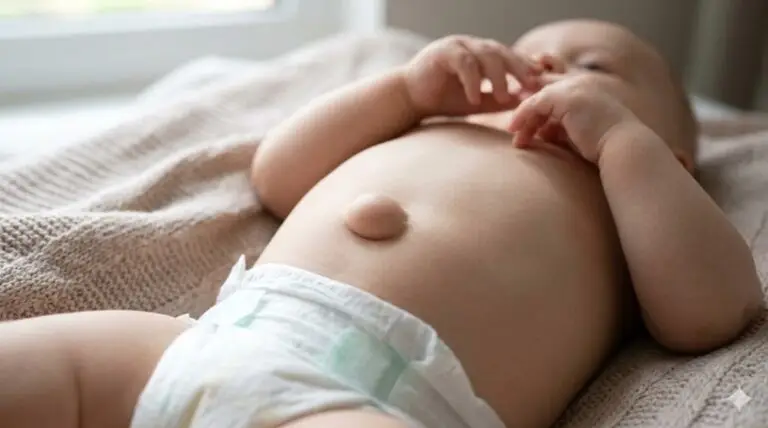
Umbilical hernia in children – information and treatment instructions
An umbilical hernia is a very common and almost always harmless condition in children. It appears as a soft bulge near the navel, which becomes more pronounced when the child cries, laughs or exerts himself.
Why does an umbilical hernia occur?
An umbilical hernia occurs when the opening for the umbilical cord in the abdominal wall does not close completely after birth. This allows the contents of the abdominal cavity (usually fat or intestines) to protrude through the opening under the skin, forming a visible sac.
Follow-up: Most umbilical hernias heal on their own
Unlike an inguinal hernia, an umbilical hernia in a child will most often heal without treatment.
Self-closing: The majority of umbilical hernias close as the child grows and the abdominal muscles strengthen.
4 years of age: In Finland, umbilical hernias are usually monitored Up to 4 years of age. If the hernial sac is still open after this, it is unlikely to close on its own, and surgery may be considered.
No need for taping: Taping an umbilical hernia or ”button treatments” do not speed up the closure of the opening and are not recommended.
When is surgery necessary?
An umbilical hernia is usually only operated on during childhood (over 4 years of age) if:
The hernial port is still clearly open.
The hernia is large or causes cosmetic damage.
The hernia causes pain to the child (rare).
Note! Incarcerated umbilical hernias are extremely rare in children. However, if the belly button suddenly becomes painful, hard, or red, you should seek medical attention immediately.
Umbilical hernia surgery and recovery
If your child has decided to have umbilical hernia surgery, the procedure is routine and safe.
Before surgery:
The surgery is performed as a day surgery procedure under general anesthesia.
The child must be fasted (without eating or drinking) according to the doctor's instructions before coming to the hospital.
Procedure:
The surgeon makes a small, curved incision at the bottom of the navel.
The hernia sac is drained and the opening in the abdominal wall is usually closed with dissolvable sutures. Hernia meshes, which are used in adults, are not necessary in children.
The base of the navel is reattached, giving a neat and natural finish.
Home care and recovery:
Pain management: After surgery, the child will be given regular painkillers (e.g. paracetamol or ibuprofen) for a few days.
Wound care: The wound usually has dissolvable stitches that do not need to be removed. The wound is kept clean and dry according to instructions. You can usually shower after 24 hours.
Exercise: Light exercise is allowed immediately, but strenuous exercise, sports, and swimming should be avoided for about 1-2 weeks, depending on the child's age, to allow the wound to heal in peace.
Health library link
https://www.terveyskirjasto.fi/dlk00532
Duodecim article
https://www.duodecimlehti.fi/duo97005
Philadelphia CH link