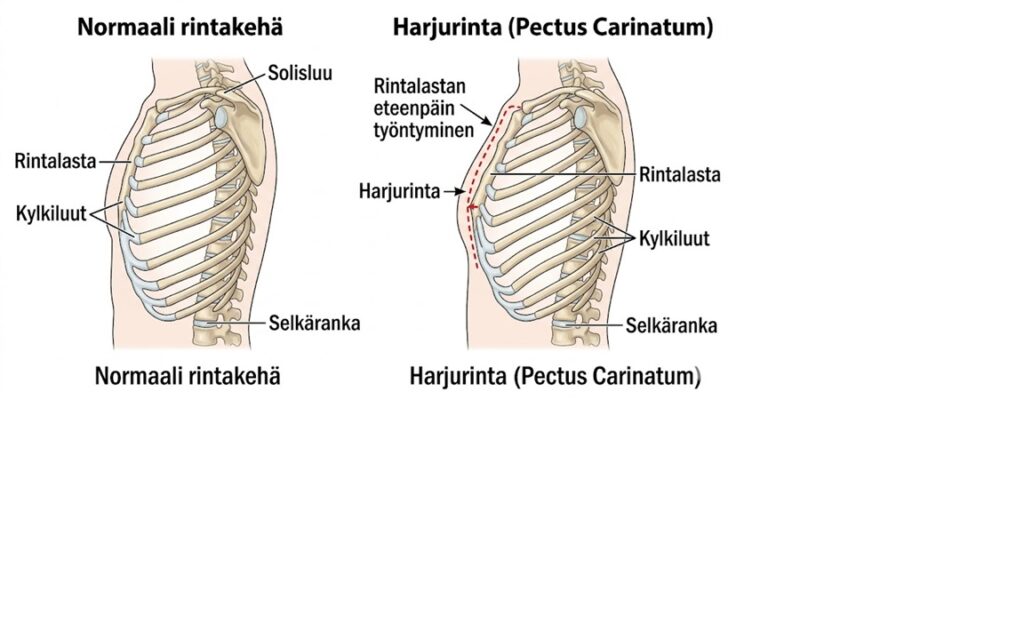
Crested breast (Pectus carinatum)
A humpback is a structural abnormality of the chest in which the sternum and ribs protrude outward. For this reason, the condition is often called ”chicken breast.” It is significantly more common in boys than girls, occurring in about one in a thousand children.
Symptoms and development
Looks: The most obvious symptom is a protruding chest. The shape is often asymmetrical, with one side of the chest being more prominent.
Growth: The situation typically worsens as the child grows, especially during the growth spurt of puberty.
Pain: Most children are asymptomatic, but some may experience pain during physical exertion.
Associated diseases: Approximately 15 percent of children also have a curvature of the spine, or scoliosis.
The whys and wherefores
The exact cause of scoliosis is unknown. Although most children do not have a family history of the condition, genetic factors are believed to play a role in the development of the condition.
Examinations and diagnosis
A doctor usually diagnoses a hernia during a routine physical examination. Additional tests may sometimes be needed to rule out other conditions:
Treatment options
Mild cases usually do not require treatment, but are monitored. If the damage is moderate or severe, there are two options:
1. Brace
Best suited for children whose chest is still flexible (before the end of puberty).
A custom-made corset is made for the child, which presses on the protruding area and gradually shapes the chest.
Treatment may last 1-2 years
2. Surgical treatment (Ravitch method)
Surgery is only rarely considered in severe cases or if corset treatment does not work.
During the operation, the surgeon removes excess cartilage and reshapes the sternum into the correct position.
When to contact a doctor?
Jos lapsen rintakehä työntyy selvästi ulospäin (tai kosmeesi muuten häiritsee lasta) tai jos lapsi valittaa rintakipua urheillessa.
Link to Boston children's hospital article
https://www.childrenshospital.org/conditions-treatments/pectus-carinatum