Foreskin stenosis and circumcision in a child
Phimosis is a common condition in children, but not all cases require surgery. It is important to distinguish between a normal developmental stage and a condition that requires treatment.
Note: Our practice only performs circumcisions for medical reasons. We do not perform religious circumcisions.
When is it okay to do nothing to the foreskin?
The foreskin of a prepubescent child is often physiologically tight, which is normal. If the child has no symptoms, the condition does not need to be treated and may resolve on its own as the child grows.
When should treatment be considered?
Treatment is necessary if a tight foreskin causes the child problems, such as:
Recurrent foreskin infections (surgical treatment is extremely rare, infections usually subside with age with proper care instructions)
The foreskin is often sore or cracks and bleeds.
The urine stream is abnormal (the pee stream does not hit the penis or the foreskin ”balls” when urinating).
Lichen planus (BXO) – The most common reason for surgery
In Finland, the most common reason for circumcision of a child or adolescent is Balanitis Xerotica Obliterans. It is a scarring disease of the foreskin that makes the skin tight, pale, and inelastic.
To white lichen the only effective treatment is the removal of scarred skin, or circumcision.
Treatment options
The choice of treatment depends on the symptoms and possible underlying disease:
Medicated cream (Bemetson): If it is a simple congestion without signs of lichen planus, you can try a strong cortisone cream (Bemetson) for about two weeks. The cream softens and loosens the skin.
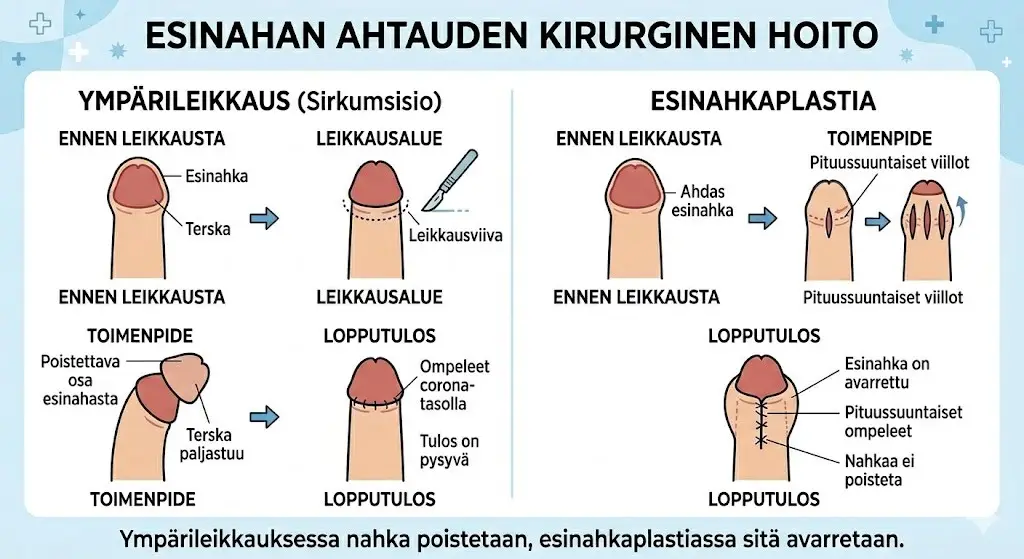
Foreskinoplasty: If the skin is tight and there is no scarring, plastic surgery may be considered. This procedure does not remove the skin, but rather reshapes it to make it looser.
Circumcision: If cream treatment does not help or it is lichen planus, circumcision is performed, in which the narrowed or diseased part of the foreskin is removed.
Instructions for those undergoing surgery
The surgery is usually performed under anesthesia to make the procedure painless and fear-free for the child.
Recovering at home:
Pain management: Regular pain medication is important for the first few days (e.g. paracetamol and ibuprofen).
Hygiene: The area is kept clean by showering daily. Loose, soft cotton underwear is recommended.
Recovery time: You can usually return to school or daycare after a few days.
Trammels: Exercise, sports, saunas and swimming should generally be avoided. about two weeks after surgery.