Inguinal hernia in children – information and treatment instructions
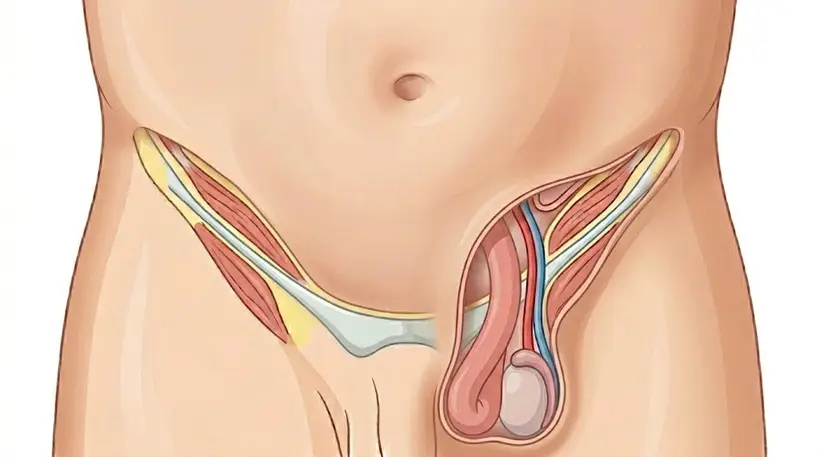
Inguinal hernia is the most common condition requiring surgical treatment in children. In an inguinal hernia, the fetal connection between the abdominal cavity and the inguinal canal has not closed normally. In this case, the intestine, the stomach lining, or in girls, the ovary can protrude from the abdominal cavity into the inguinal canal, which is visible as a bulge.
Basic information about inguinal hernia
Prevalence: Inguinal hernias occur in a few percent of children.
Who experiences it: Hernias are about six times more common in boys than in girls.
Location: The hernia is typically on the right side, but in about 10 percent of children it is bilateral.
Typical form in children: A hernia in children is almost always an indirect hernia; a direct inguinal hernia in adults is extremely rare in children.
Symptoms and identification
Inguinal hernia is often seen as a painless lump or bump in the groin.
At the reception: The hernia may be visible and palpable during a medical examination, and it can usually be easily pushed back into the abdominal cavity.
At home: Often, a hernia only becomes apparent when a child cries or strains. Even if the hernia is not visible at the doctor's office at that exact moment, the parents' observation of an occasional bulge is usually enough to make a diagnosis.
Hernia reduction
An inguinal hernia carries a risk of strangulation, which means that the organ pushed into the hernia sac becomes compressed.
Babies: Children under one year of age are at the highest risk of suffocation (up to 25% in %).
Toddlers and parents: In those over one year of age, the risk decreases significantly and is less than 10 %.
Note! If the lump in the groin becomes painful, hard, or does not go back when pressed, contact the emergency room immediately.
Treatment: Surgery is the only treatment
A child's inguinal hernia does not heal on its own, so it is always treated with surgery to avoid the risk of strangulation.
Measures: The surgery is performed through a small incision in the groin.
What to do: The open connection is closed with a dissolvable suture.
Recovery: Children do not need a hernia mesh or other separate reinforcements, as is common in adult surgeries, and recovery is usually quick.
Duodecim article about inguinal hernia surgery in a child
https://www.duodecimlehti.fi/duo14844
Health Library article about hernias in children
https://www.terveyskirjasto.fi/dlk00532
Boston Childrens Hospital article
https://www.childrenshospital.org/conditions-treatments/inguinal-hernia